As a young man pursuing a writing career in New York City, I once worked a temp job assisting the head of the National Hockey League. I would do the work he put in my inbox as quickly as I could, so I could get back to reading The Red and the Black.
This annoyed him. "When you finish a job, you should look around for something else productive to do, like reorganizing the files. Think of it this way: right now you're a temp secretary. But work hard, and someday you could become a full-time secretary."
Bless his heart. And I shouldn't have been reading on the job. But the mismatch between what he thought I wanted—a full-time secretary position—and what I actually wanted—to swim in the world of great literature—was so great that we might as well have been living on different planets.
As we were.
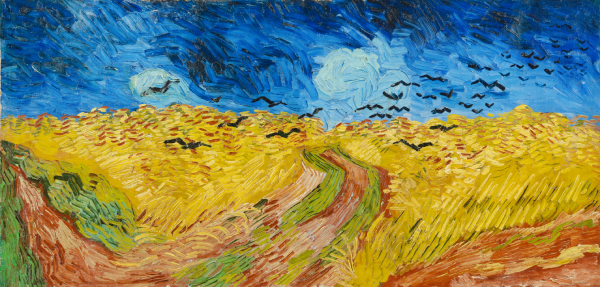
Which brings me to Vincent van Gogh, whose letters I'm now reading. The impoverished, tormented and brilliant artist shot himself in the chest in a wheat field near Auvers-sur-Oise in 1890 and died two days later.
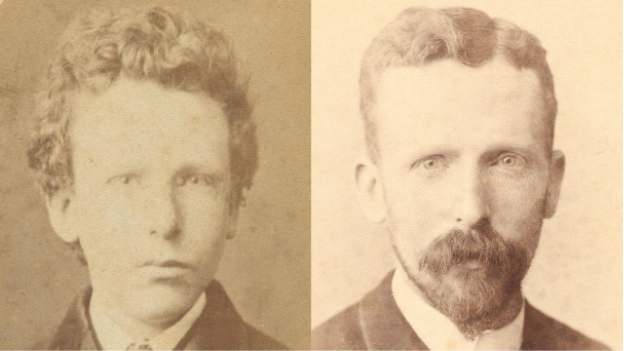 During his years of struggle to express himself through his art, Vincent (at right in the photo) was famously supported by his brother Theo, a successful Parisian art dealer who kept him alive with a monthly stipend.
Yet Vincent felt frustrated. In an 1884 letter, responding to Theo's opinion that his work needed to improve, he wrote:
"You have never yet sold a single thing of mine—not for a lot or a little—and IN FACT HAVEN'T TRIED TO YET."
Of course Vincent wanted to sell his work and begin making his own way in the world. It must have been infuriating that his brother, with his art-world connections, couldn't sell even a small piece.
But not selling was one thing. Not trying was what really hurt. Theo cared enough to keep Vincent afloat—but not yet enough to stake his professional reputation on the work.
Theo admired the Impressionists and was later praised for his "tireless efforts" on behalf of Monet, Degas and Pissarro. Yet in 1884, he seemed unwilling to make the same effort for his own brother.
And perhaps Vincent, living in his other world, demanded too much understanding from Theo. Like the hockey executive and me, the brothers were both talking about "work," but they did not mean the same thing.
Theo saw the difficult product of an unproven painter.
Vincent saw the one thing for which life was worth enduring.