“Genius,” Thomas Edison is reputed to have said, “is 1% inspiration and 99% perspiration.”
Not sure how that works out in the world of inventing, but it’s only half true in the world of writing a novel.
For the past year, I’ve been working on the next James Dain novel in my Hard Knocks series—The Little Guy Always Gets Screwed. A harassed swimming pool contractor in Southern California gets drawn into a conspiracy of murder and corruption when his son is framed for a fatal traffic accident he didn’t cause.
It’s loosely based on a real-life incident here in Palm Springs, in which the mayor of the town was arrested for taking bribes from a commercial real estate developer in exchange for favors in a redevelopment project.
On the surface, writing a novel doesn’t seem much different than writing a lengthy college term paper. You do some research, pin down an idea you want to argue, construct an outline to help organize your facts, and plod your way through to the end, editing and polishing along the way.
That’s 1% inspiration and 99% perspiration.
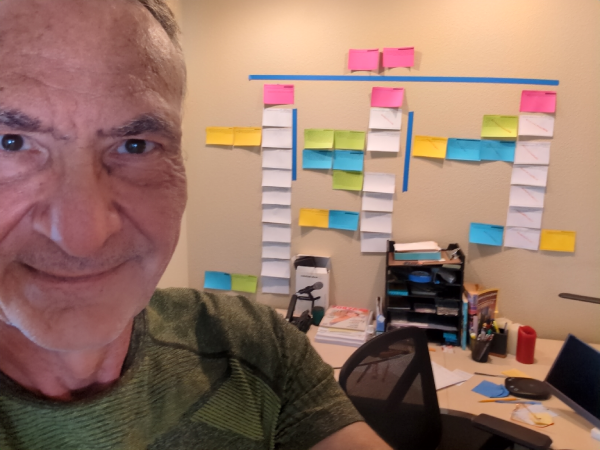
But in writing a novel, the equation shifts. Yes, you still need to do that research, and figure out what you want to say, and construct an outline that lays out your story from beginning to end. In fact, for Little Guy, I went all in and outlined every character and every scene, so that my wall became a massive collage of various colored index cards.
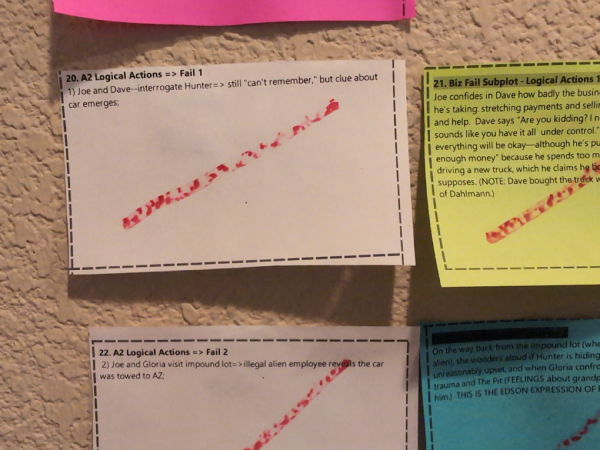 But once I began actually writing the novel, things rapidly got fuzzy. In a novel you are making your “argument” through fictional personalities striving to get what they need and want, despite everything that stands in their way. And fictional personalities don’t feel like real people until they’re set in concrete situations like the ones real people face every day. And when they become alive in an author’s imagination—and eventually in a reader’s—they may take actions and make decisions you could never anticipate, thus blowing apart your initial outline, no matter how detailed it is.
For instance, in Little Guy, I was halfway through the book before I realized that the secret witness the D.A. was going to call to convict my protagonist’s son of vehicular manslaughter was not ________, as my outline suggested, but none other than ________—who of course was willing to lie in court for reasons I can’t reveal without blowing up the plot.
(You can fill in the blanks when you read my novel, sometime in mid-2027.)
I don’t mind outlining and have a pretty good grasp of story structure, but the reality is that, every time I write a novel, at least half the story reveals itself to me only as I write it. E. L. Doctorow compared writing a novel to driving a car at night: “You never see farther than your headlights, but you can make the whole trip that way.”
That feels right to me. The perspiration comes from applying your butt to the seat of the chair every morning. The inspiration is what appears in the headlights after you’ve already started driving.
And if you’re really lucky, the two together may take you somewhere better than the place you thought you were going.